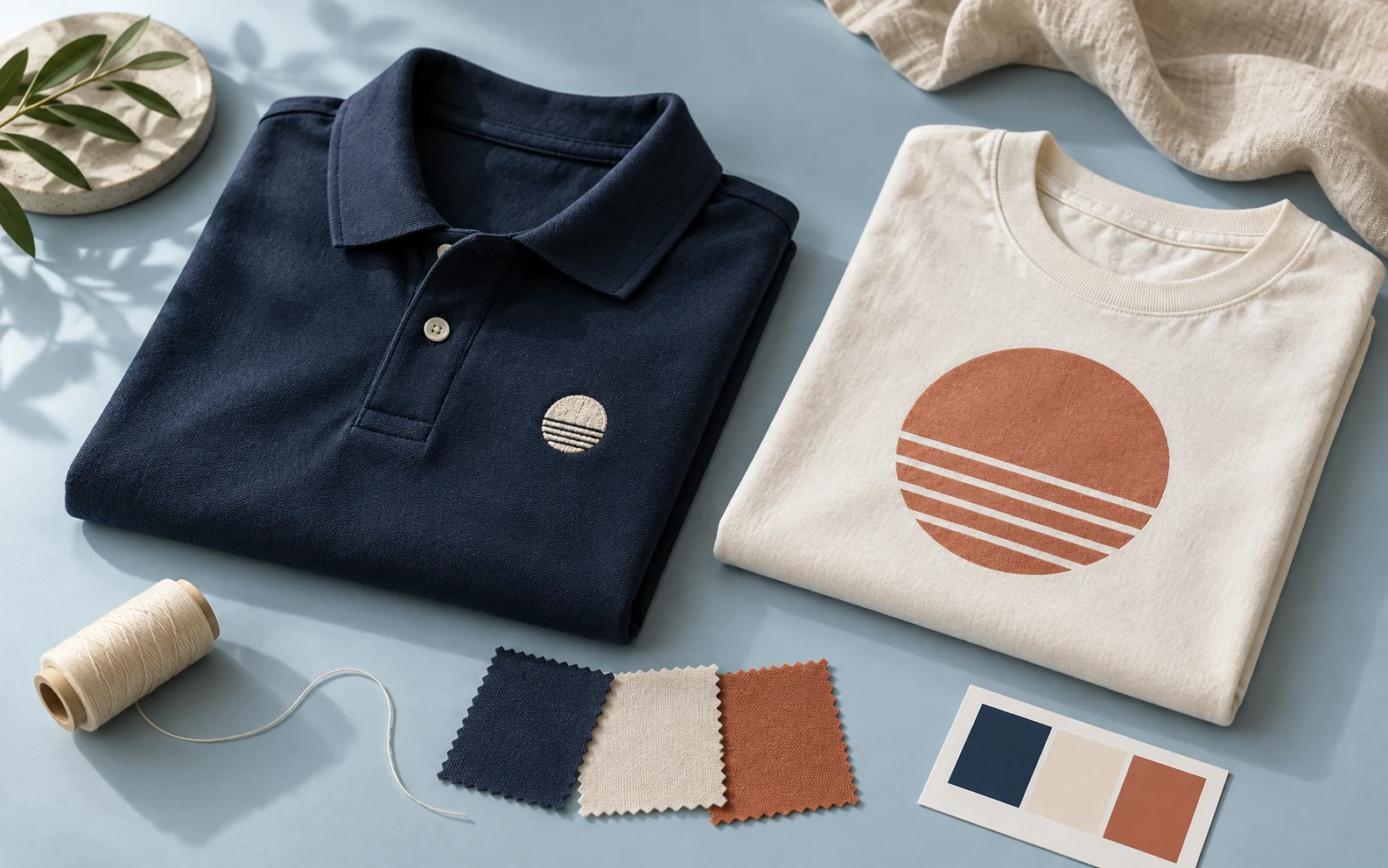
Choose embroidery when you want a compact, textured mark and the garment can support the stitching. Choose printing when the design needs a larger canvas, tonal detail, or a flatter finish. In either case, approve a decorated sample on the exact garment—not just a logo mockup.
That is the useful answer to “Should we embroider or print our company apparel?” The less useful answer is that one method is always premium, cheaper, or longer-lasting. A beautifully stitched logo can still feel wrong on a lightweight shirt. A printed graphic can look excellent, but the wrong ink or transfer for the fabric can undermine the result.
For an employee store, you are making two decisions at once: what people will enjoy wearing, and what your program can reliably reorder. This guide separates those decisions so you can approve an assortment with fewer surprises.
Publisher perspective: this is a Brand Sauce editorial buying guide, not a laboratory comparison or a claim that every method is available on every product. Technical references were checked September 18, 2026. The hero is an AI-generated editorial illustration, not a photograph of tested merchandise.
A quick decision table for your next apparel order
Use these as starting points for a sample request, not automatic production approvals.
| What you are buying | Start by evaluating | What to check before approval |
|---|---|---|
| Office polo with a small chest mark | Embroidery | Letter clarity, fabric puckering, inside backing and comfort |
| Event T-shirt with a large graphic | Screen print, DTG or a suitable transfer | Print feel, color, fine detail and the full order quote |
| Lightweight stretch performance shirt | Both, on the actual fabric | Movement, distortion, heat sensitivity and decoration compatibility |
| Fleece layer with understated branding | Embroidery or a compatible print/transfer | Visibility against the fabric texture and wearer comfort |
| One-at-a-time employee reorders | A method supported for that exact item and order size | Reorder price, lead time, retained artwork and substitution rules |
| Detailed illustration or gradient | A print process capable of reproducing the artwork | A physical proof; “full color” alone is not an approval standard |
First, stop treating printing as one method
Embroidery creates the design with stitches. Screen printing applies ink through a stencil screen and cures it. Direct-to-garment printing, or DTG, applies ink directly to fabric. Transfers are applied with heat and pressure; direct-to-film, or DTF, is one type of transfer workflow. SanMar's decoration education overview explains the basic distinctions.
Those categories are not interchangeable. Ask a supplier what “printed logo” means in the proposal. Record the method alongside the garment style, color, decoration location and artwork version. Otherwise, you can approve one finish and accidentally compare its price with a very different finish later.
For the buyer, the key questions are straightforward: how does the finished area look, how does it feel, how should it be washed, and can it be produced again under your ordering model? You do not need to become a machine operator. You do need a clear description of what you are buying.
Choose for the fabric before choosing for the logo
A category name is not a specification. Two “performance polos” may differ in fiber blend, stretch, weight and surface texture. The decoration decision belongs to the exact style and color, not to the word polo.
SanMar's August 2026 guide to decorating modern performance fabrics identifies heat, adhesion and stretch considerations for modern blends. Its practical implication for buyers: ask the decorator to confirm compatibility with the actual garment instead of assuming that a method approved on one shirt transfers to another.
Embroidery also needs fabric-specific preparation. SanMar's lightweight performance fabric guidance explains that stretch, stabilization, digitizing and stitch density affect the outcome. Dense stitching can create problems on lightweight materials. A digital rendering cannot show how the garment will hang once stitched.
Printing has its own watchouts. SanMar describes dye migration as garment dye changing the print's color, with effects that may emerge hours or days after printing. For polyester apparel, ask how the chosen decoration system addresses that risk and when the sample will be inspected. Do not invent a universal heat setting from a general buying guide.
For coated or technical outerwear, make compatibility an explicit approval question. Ask whether the proposed decoration affects the garment's intended properties and whether the manufacturer permits that application. If the answer is uncertain, choose a different placement, method or garment before adding it to the store.
Make the artwork work at its real size
Your website logo is not automatically your best apparel logo. At chest size, a long tagline may become the least readable part of the design. At a larger scale, a heavy block of decoration may dominate the garment.
Before asking for a quote, prepare an apparel artwork brief:
- Required elements: identify the symbol or name that must remain recognizable.
- Optional elements: decide whether a tagline, founding date or secondary text can be removed with brand approval.
- Finished dimensions: specify the intended width and height, not just “left chest.”
- Color references: provide your brand standards and define who approves the physical match.
- Placement: request a clear reference point and review it across the offered garment sizes.
There is no useful universal minimum letter size for every embroidered logo. Madeira's embroidery thread guide describes finer threads intended for small lettering and detail. That does not mean every decorator, fabric and design can reproduce the same tiny text. Ask for a sew-out of your artwork at its proposed size.
Color approval deserves the same discipline. Madeira cautions that screen and paper representations may not precisely match actual thread and recommends physical color references in its thread resources. If a close brand match is important, approve the real material. A screenshot of a color chip is not enough.
Keep a simplified apparel mark in your approved artwork library if you create one. Name it clearly and retain the original brand artwork too. This prevents someone from repeatedly rebuilding a tiny logo from an old order confirmation.
The sample approval checklist that matters more than the mockup
A mockup approves the idea. A production-representative sample approves the execution. Request one on the actual garment style, fabric and color, using the proposed method and finished dimensions. If a substitute sample is necessary, document what it cannot prove.
| Check | What the reviewer should do | What to record |
|---|---|---|
| Appearance | Inspect the design at normal viewing distance and close up | Legibility, color approval and any lost detail |
| Drape | Lay the garment flat, then try it on | Puckering, pulling, stiffness or placement concerns |
| Inside finish | Examine the reverse side and wear against an appropriate base layer or skin | Backing visibility and comfort feedback |
| Movement | Move naturally in the garment | Whether the decoration feels restrictive or distorts |
| Care | Follow the agreed instructions for the decorated item | Appearance before and after washing, with photos |
| Repeatability | Confirm the sample represents normal production | Artwork version, method, dimensions and approved exceptions |
Agree on a practical wash check with your supplier before the order deadline. A small internal check can identify an obvious issue; it is not a certified durability study and should not become a public “lasts X washes” claim.
Obtain care instructions for the finished combination of blank garment and decoration. For example, STAHLS' UltraColor MAX page gives product-specific laundering instructions. That is a useful reminder to avoid writing one generic care message for all printed apparel.
Nominate one final approver and save the approval with photos. A comment such as “looks good” without a linked artwork version or style number leaves too much room for interpretation when a replacement order happens months later.
Compare the first order and the next order
Do not compare an embroidered polo with a printed T-shirt and attribute the entire price difference to decoration. The garment itself, artwork, location count, order quantity and delivery arrangement all change the purchase.
Request like-for-like quotes where possible. Ask suppliers to separate the blank, decoration, setup or digitizing, extra locations, packaging and delivery. Ask which charges recur and which are retained for future orders. These are questions to verify, not a claim that every supplier charges each fee.
Illustrative arithmetic—not supplier pricing: suppose one quote has a $60 setup charge and $8 decoration per item, while another has no setup charge and $11 decoration per item. At 20 items, both decoration totals are $220. At five items, they are $100 and $55. At 100 items, they are $860 and $1,100. This excludes garments, shipping, tax and all other charges; it does not establish that either quote represents embroidery or printing.
The lesson is to compare the actual quantity and reorder pattern. A one-off event and a year-round store are different purchasing problems. Ask what happens when a new employee orders one item, a department orders twelve, or a replacement is needed urgently.
Bulk can be sensible for a stable design, known quantities and a shared event deadline. On-demand can suit uncertain individual demand when the required item and decoration are available under that model. A hybrid program might keep an event batch separate from an employee-choice assortment. None is automatically cheapest. Our on-demand versus bulk guide explains the broader decision, while the swag program cost guide helps you account for more than the unit price.
Turn the decision into company-store rules
A good company store does not need one decoration method everywhere. It needs a coherent look and a documented approval process.
For a hypothetical assortment, you might evaluate a small embroidered mark on a substantial polo, a printed illustration on an event tee, and a restrained decoration on a lightweight layer after testing. These are planning examples, not Brand Sauce client results or promises of availability.
For each approved item, retain a simple record:
- Garment brand, style, color and offered sizes.
- Decoration method, location, dimensions and artwork version.
- Physical sample approval and final approver.
- Care instructions and any wearer feedback worth addressing.
- Current price basis, order-size rules and quoted production expectations.
- Substitution rules: which changes require a fresh approval.
Make substitutions deliberate. A replacement style should not inherit approval merely because it is also navy or also described as performance fabric. Ask whether the existing artwork and process remain suitable, and require a new sample when the change could affect the result.
This is also an assortment decision. Avoid filling the store with near-identical garments just to offer more listings. Our product curation guide helps build a smaller collection with distinct reasons to choose each item.
Frequently asked questions
Is embroidery always more professional than printing?
No. A compact embroidered mark may suit an office polo; a considered print may suit a creative team's T-shirt better. Judge the finished garment against its audience and use, not a hierarchy of decoration labels.
Which lasts longer?
There is no universal winner across all fabrics, threads, inks, transfers and care routines. Evaluate the exact decorated sample and the supplier's documented care guidance. Do not turn a single product's durability claim into a promise about an entire method.
Can we embroider lightweight performance shirts?
Potentially, but the specific fabric, artwork and production setup matter. Require a sample and inspect its drape, stitching and comfort. “Performance” is not an automatic yes or no.
Does no-minimum ordering mean every decoration is available one at a time?
No. Confirm the rule for the exact product, artwork, decoration location and destination. Ask separately about first orders, reorders and setup charges rather than relying on a store-level headline.
Should employees choose embroidery or printing at checkout?
Usually, make the technical approval decision before launch. Offer a curated choice of finished products instead of asking employees to evaluate decoration compatibility. If you offer method variants, approve and describe each one clearly.
Approve the garment, not just the logo
The strongest decision is not “embroidery wins” or “printing wins.” It is: this artwork, on this garment, with this method, looks and feels right—and we know how to reorder it.
Start with a short list, get comparable quotes, inspect decorated samples and keep the approval record. If you are planning a Brand Sauce company store, bring us your apparel brief: who will wear it, how it will be ordered, the look you want and the deadline that matters. Those are better starting points than choosing a method in isolation.